
One of the major headaches when going on a trip is getting from one place to another. You don’t want to get stranded in a foreign city, not knowing how to get to your destination. That is why our first rule of planning a trip is stay in a hotel near a major station that serves both metro and intercity trains.
In many cities, trains are cheap, fast and very reliable. Compared to buses that can be trapped in a traffic jam, trains are free from that kind of problem. In Japan, where mass rapid transit system and high-speed trains are as common as rice, you barely need any other form of mobility to explore the country.
Of course, not every country has a extensive railway system. When that is the case, our next best option is to ride a bus. Because of the expensive fares, we rarely use a taxi, unless there are no better option. For example, when we have to get to the airport very early in the morning.
We still had this line of thinking when we went to South Korea. We booked a hotel just outside of a Seoul Metro Subway station exit, so we could take the trains to get there from the airport, and so we could use the metro to get around the city. It worked well during our excursion around Seoul. But the story took an unexpected turn when we went to Busan.
Busan did have a subway system, but it didn’t serve the entire city.
Gamcheon culture village was located on a hilly side of the city, outside of the network. From the airport, we had to take an express bus to the main bus terminal, then changed to a city bus and then walk for nearly two miles along uphill streets to reach it. .
After spending a few hours exploring the village, we were spent, and the prospect of having to walk all the way back to the bus stop was not interesting. We saw several taxis near the exit, so we decided to save our energy and splurge on what we thought an expensive way to get around.
As the taxi pulled away, the driver seemed to sense that we were worried about the fare. I don’t know where he got that impression. Maybe he caught that from the keen way we looked at the meter. Maybe he saw our tired expression, or maybe it’s something that he had seen in the faces of tourists he had driven before. “You know,” he said in halted English, “not like in other countries, taxi here is not expensive. You can go anywhere easy using taxi. Don’t use bus. You will confuse. Just call taxi, you go faster and safer.”
Confused is to say the least. His remarks reminded me of our bus ride earlier. As soon as we climbed into the bus, we just realized that there every information in there was written in Hangul. We had some idea of the name of the place where we should get off, but we knew it in Latin alphabet. So we could not know for sure when we had to get ready to get off the bus.
That day really taught me a lesson about being prepared and being open minded. Not everything we learned in the past is applicable in the future. You must take time to learn thoroughly about the situation you are facing, and refrain from making assumptions. Some version of past solutions may work for the problem you are handling now, but there ought to be some flexibility to adapt.
From then on, checking taxi fares become part of my transportation checklist when preparing a trip to a new country, so I have a plan B in case there are no reliable mass transport.
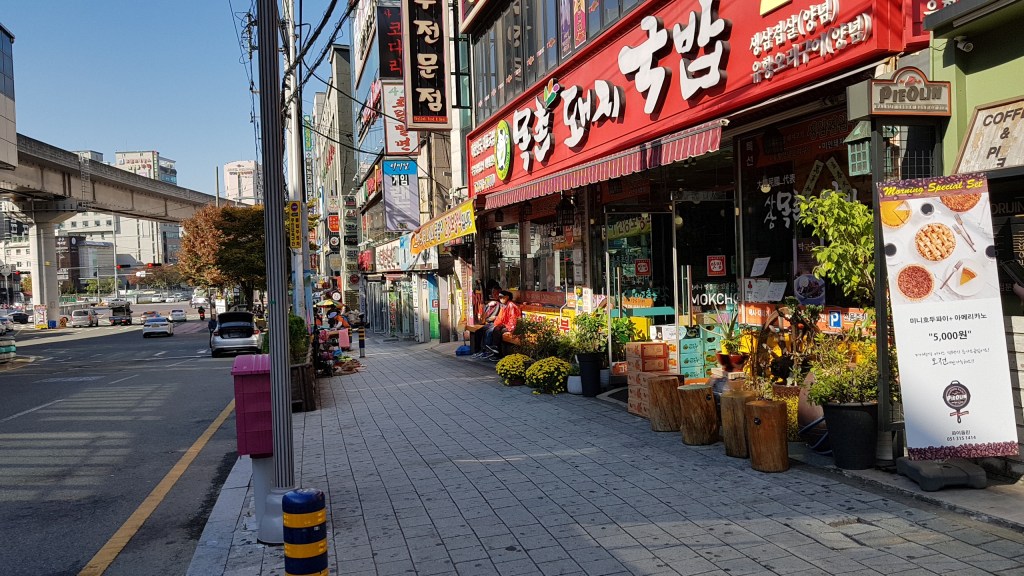
Featured Image: Morning in A Street of Busan. Photo: Stephen Siregar (2018). All Rights Reserved. Do not use without written permission.
 Life At Slow-Mo
Leave a comment