
All Rights Reserved. Do not use without written permission.
When SARS made the news in 2003, the number of people who wore masks was very, very few. So few that they who did drew curious stares. It wasn’t that SARS was not serious. In the period of its outbreak between 2002 and 2004, over 8,098 people worldwide were infected and 774 people died from the disease. But there were only two cases in Indonesia out of over 220 million population. There were some concerns, but no strong reason to take preventive action.
In 2002, both factual and fake news traveled at the speed of clunky dial-up modems tethered to desktop computers. Only 9.2% of the world population was connected to the internet. If you were lucky enough to live in the US, you could get 880 kbps speed. But if you lived in developing countries, like I did, a 144 kbps was the best you could get. It is also notable that in that year, Mark Zuckerberg was still a freshman in Harvard and social media was still in its infancy.
Fast forward to 2019, you can follow in real time the novel coronavirus progress. News spread so fast, the fear arrived long before the first case is reported in a country. Before the first patient arrived in the hospital, it was already difficult to find face masks in the market at normal price.
Finally the inevitable happened. On March 2, 2020, President Joko Widodo announced that two people had been tested positive for Covid-19. It wasn’t something that happened to a distant country anymore. It’s here.
The Indonesian government is taking measures to slow the contagion, take care the infected, and to keep the economy from collapsing. They assigned special hospitals for Covid-19 patients. They suspended tax filing deadline. Provincial and city governments tells companies to send their workers home and continue working from there. School and religious activities are moved online. Right now we are under a 14-day stay-at-home restriction.
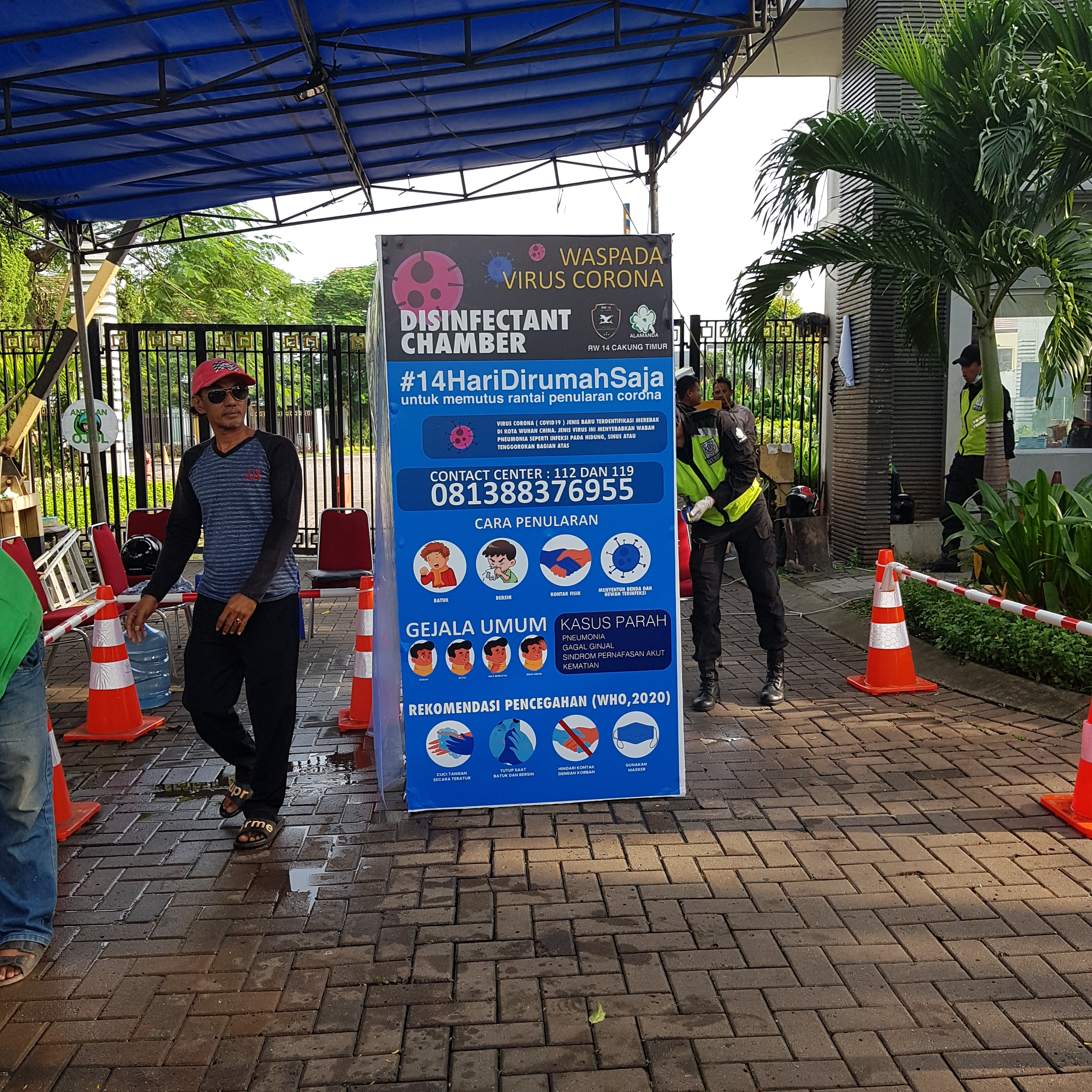
I consider my neighborhood to be exemplary in supporting the government anti-covid-19 initiatives. They put strict control on people who are coming to and going out of the residential complex. Out of their own money, they installed a disinfection chamber at the gates. Anyone coming in must go through body temperature check, disinfection spray in the chamber, and hand washing.
Right now, my concern is not getting infected. I am staying home, keeping away from crowds, washing my hands frequently, eating right and taking vitamin C supplement. I am optimistic that I will stay healthy until the pandemic is over.
China, the epicenter of the Covid-19 is one of the largest market for Indonesian export, and as their economy is slowing, our economy is lagging as well. The stock market tanks, and the rupiah exchange rate to US Dollar is suffering. Since the coronavirus warning was announced, several clients put their orders on hold. We have to suspend our training programs to comply with the stay-at-home restriction. We will miss our sales target for this month, and for the months ahead. Cash is draining fast, and there is no sure sign when this crisis will be over.
We are working hard to avoid the worst. We stay in touch with our clients. We cut expenses. We look for new opportunities. We prepare new products suited for the situation. We keep the team spirit high. We keep our heads out of the water. But deep inside our gut, we know this may not be good enough to keep us afloat until the storm passes.
It’s like realizing that you are driving in a slow motion on a collision course. You hit the brake, but you are not slowing down. As the other vehicle is careening down on you, panic is slowly building inside you, but there is nothing you can do to stop it.
We can only pray for a miracle.
 Life At Slow-Mo
Leave a comment